About the research topic
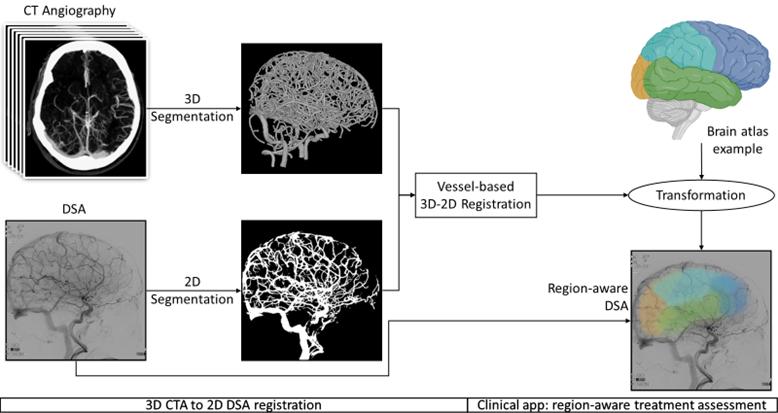
Ischemic stroke is a major cause of death and permanent disability. Since 2015, several breakthrough studies showed that patient outcome in acute stroke caused by an occlusion of a large vessel could be improved with endovascular thrombectomy (EVT). Since then, EVT has been adopted as the treatment of choice for patients with an ischemic stroke caused by a large vessel occlusion.
With the rapid developments in EVT for stroke care, further challenges and research questions arise. First, despite the procedural success rates, patients do not always achieve favourable outcome. Even in cases where good recanalization has been achieved, only 50% of the patient has good recovery. In addition, access to the brain vessels sometimes is difficult, and there is a trend towards the treatment of more distal occlusions, which makes the procedure more challenging. These new challenges call for advanced image analysis techniques in EVT treatment.
In current practice, 2D DSA imaging is used for guidance and therapy assessment during the procedure, whereas there is 3D information (NCCT, CTA) available from diagnostic imaging before the procedure. During the procedure, the 2D projective and contrast-based nature poses several challenges in treatment, such as lack of accurate anatomical information, and vasculature distal of thrombus being invisible, as well as overprojection of vessels sometimes masking the origin of the occluded vessel.
This project aims to develop and assess advanced image analysis tools to be used during EVT that support the clinician in performing EVT. The underlying hypotheses is that information from 3D baseline imaging, as well as better quantitative measures based on this information, are beneficial for the intervention, and therapeutic decision making during the intervention. The project thus will work on novel technologies, including artificial intelligence, for integration of 3D information in interventions, for automated quantitative DSA analysis and multimodal image guidance.
Funding: Health Holland
Partners: Erasmus MC, TU Eindhoven, Philips