About the project
AFRICAI-RI is a transformative initiative bringing together partners from ten Sub-Saharan African countries and four leading European institutions to create Africa’s first federated medical imaging infrastructure. By securely connecting imaging data, expertise and technology, the project aims to accelerate the development of artificial intelligence solutions that support the diagnosis of major respiratory diseases such as tuberculosis and pneumonia.
The project is coordinated by the University of Barcelona (specifically the Artificial Intelligence in Medicine Lab, BCN-AIM) and involves a consortium of 14 institutions across Europe and Sub-Saharan Africa.
Why AFRICAI-RI Matters
- Growing Demand: AI for medical imaging is growing rapidly worldwide, but most tools are not adapted to low-resource settings.
- Data Availability: Africa has rich clinical expertise but limited imaging datasets for training safe and effective AI tools.
- Specialist Shortage: Many healthcare facilities face shortages of radiologists and imaging specialists skilled in interpreting scans.
- Impact on Health: Respiratory diseases remain among the top causes of illness and death in Africa.
What We Will Do
- Secure Infrastructure: Build a secure imaging data infrastructure across Africa.
- Federated Learning: Deploy advanced federated learning technologies that keep data securely within each host institution.
- Tailored AI Tools: Develop ethical and trustworthy AI tools for X-ray and ultrasound tailored to African adults and children.
- Capacity Building: Strengthen local expertise through training, mentorship, and in-person schools.
- Clinical Research: Support clinical research through open calls and real-world validation.
Workpackage 2: Infrastructure development and data management
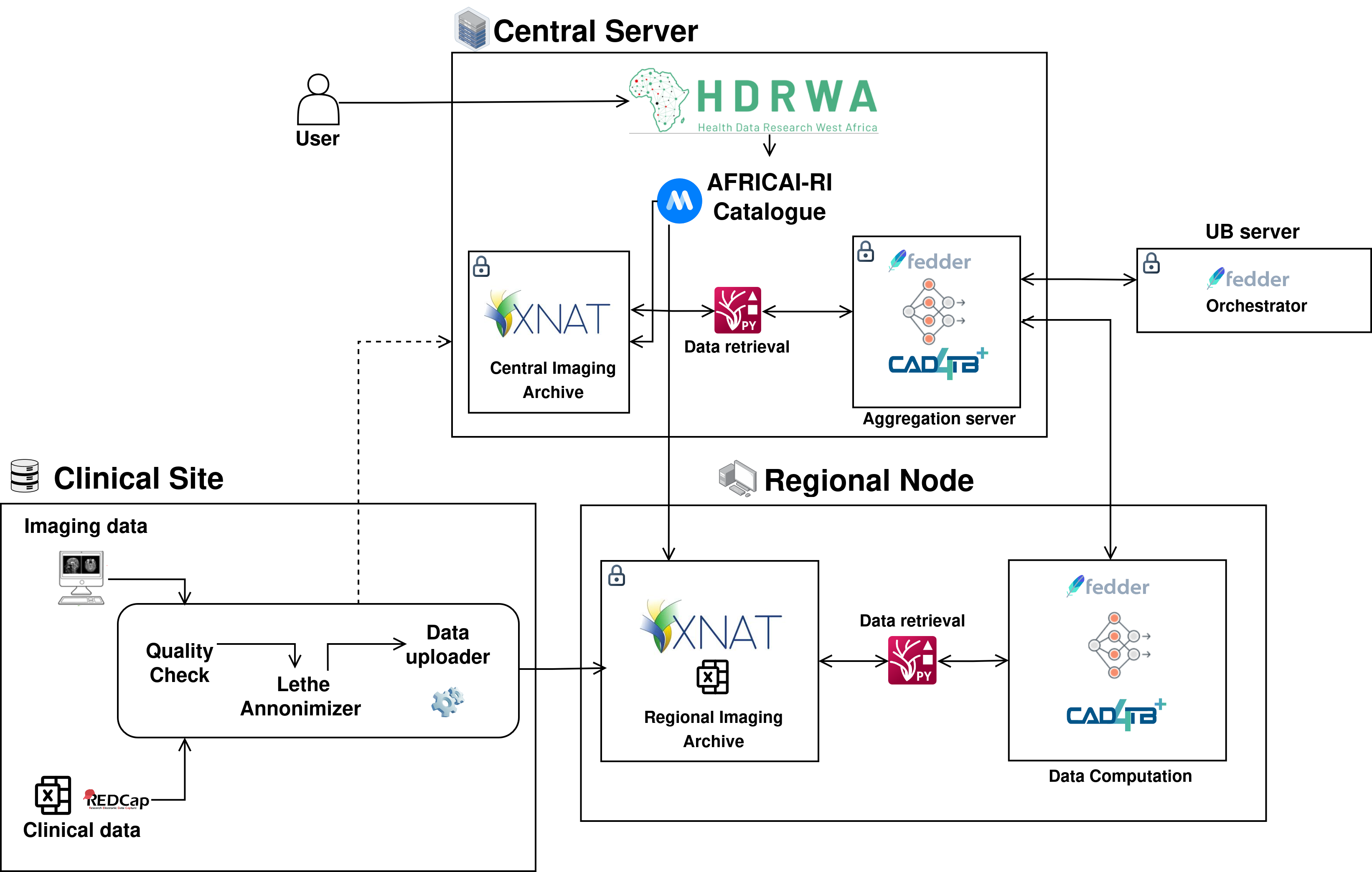
BIGR leads Workpackage 2 (WP2) and co-leads the infrastructure working group together with the Medical Research Council of The Gambia (MRCG). WP2 focuses on the design and implementation of a federated and FAIR (Findable, Accessible, Interoperable, Reusable) imaging research infrastructure. This involves:
- Establishing secure, interoperable data nodes at participating clinical research sites.
- Deploying the open-source platform XNAT at each local site to serve as the imaging archive.
- Designing the multi-institution infrastructure to allow AI models to be trained without transferring sensitive patient data, thus preserving privacy and data sovereignty.
Architectural Overview
Funding
This project has received funding from the European Union (Horizon Europe – Global Health EDCTP3 Joint Undertaking) under grant agreement No. 101140228.