About the research topic
Retinitis Pigmentosa (RP) is the most common inherited retinal dystrophy, affecting about 1 in 4000 individuals worldwide and leading to progressive, irreversible vision loss. While genetic testing has advanced, detection and monitor disease progression is limited with the current techniques, highlighting the need for sensitive biomarkers. Current imaging modalities, such as Optical Coherence Tomography (OCT) and Retinography, provide important structural information but fail to capture subtle changes in cone photoreceptor integrity, especially in early and mid-stages of RP.
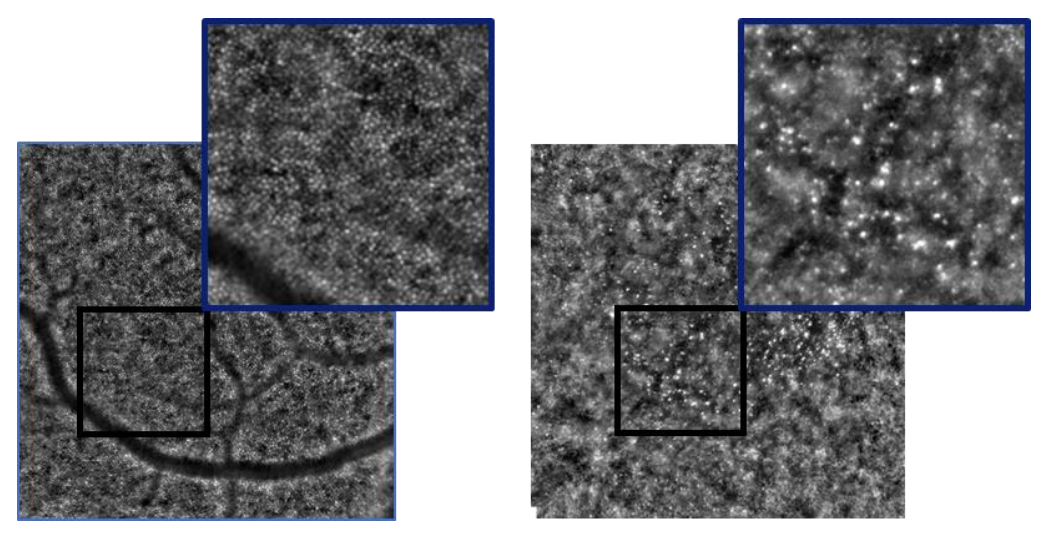
Adaptive Optics Flood Illumination Ophthalmoscopy (AO-FIO) is emerging as a powerful technique for non-invasive, in-vivo imaging of cone photoreceptors. However, RP phenotypes pose specific challenges for analysis, as cones may appear hypo- or hyper-reflective, cone mosaics are irregular, and patterns of retinal degeneration vary regionally. Manual cone annotation is infeasible at large scale, and existing automated methods fail to generalise to pathological variations.
The AICON project aims to establish AO-FIO as a clinically valuable tool for RP diagnosis and follow-up by investigating new methods for automated cone detection and phenotyping. Retrospective and prospective datasets will integrate AO-FIO, OCT, and microperimetry. OCT will quantify retinal layer integrity, while AO-FIO will provide cone-level metrics such as density, regularity, morphology, reflectivity, and spacing. Structure–function relationships will be explored by co-registering AO-FIO with microperimetry maps and by comparing cone metrics with global and subjective functional measures, including best-corrected and low-luminance visual acuity and patient-reported visual function questionnaires.
Patient experience with AO-FIO imaging will also be assessed to optimise protocols and communication. The project will deliver a user-friendly software toolbox to make AI-based cone counting and phenotyping in RP accessible to clinicians and researchers. By transforming AO data into standardised, interpretable biomarkers, AICON will provide sensitive and clinically meaningful biomarkers for monitoring RP progression, supporting patient stratification, and serving as endpoints for future therapeutic trials.
Funding: CORR, RSB